Software Development AI / Automation Systems 3D / Animation Production
01 / AIRCRAFT CASE STUDY
Build it. Stage it. Put it in motion.
A personal aerial-action production. Original geometry. Editable scenes.
The challenge was to make a pursuit, firing pass, and breakaway read as a continuous sequence. I developed the project through procedural aircraft construction, scene staging, camera and motion revisions, and an edited vertical cinematic.
My contribution
Production direction, asset and scene iteration, and orchestration of agent-assisted scripts and renders.
The deliverable
A 48-second edited cinematic study, backed by editable Blender scenes and an Unreal proof stage.
The approach
Conventional 3D geometry, materials, lights, and keyframes, with AI assistance for technical implementation and repetitive steps.
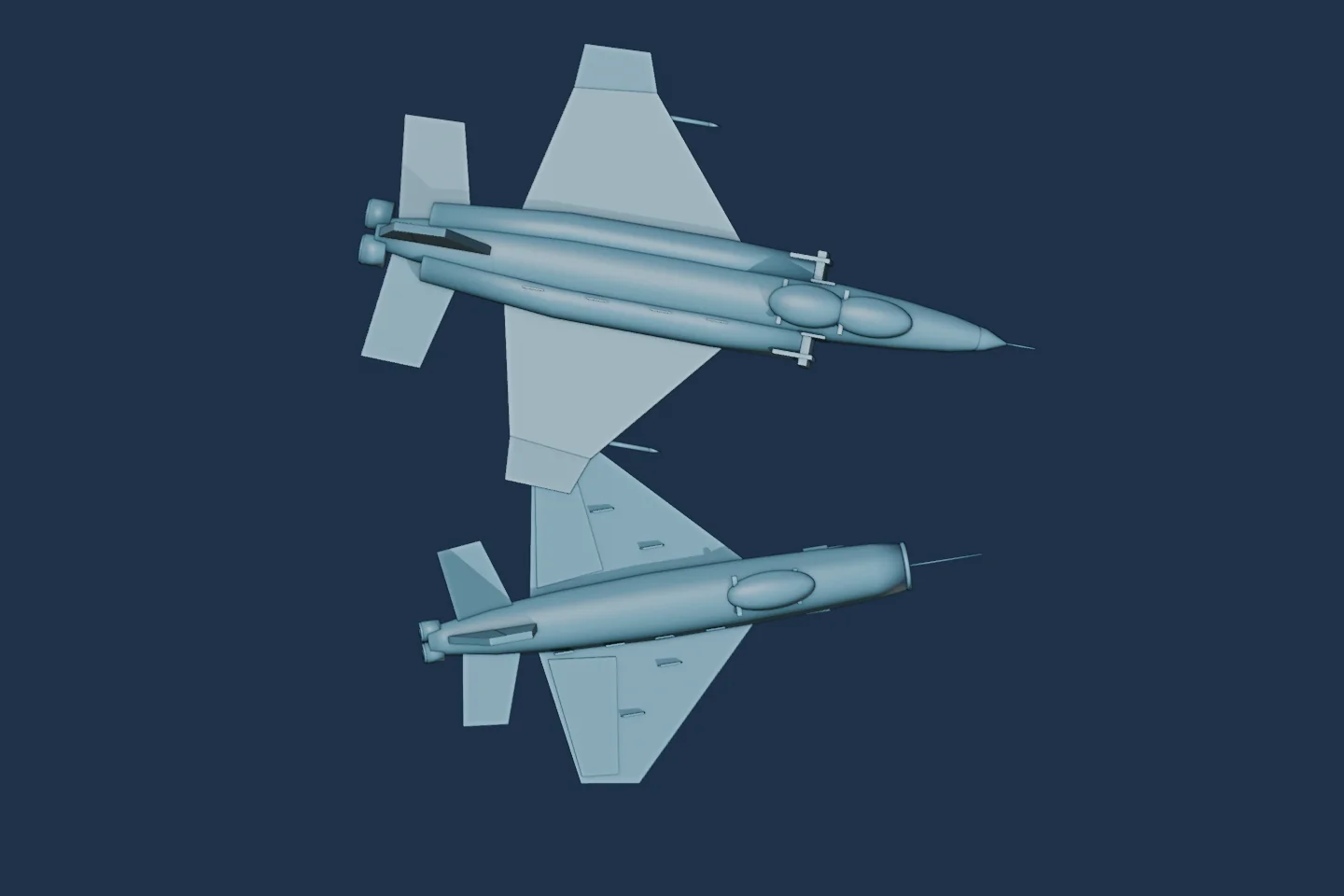
01 / Asset preparation — orthographic clay view of the same models.
THE ASSETS
Geometry with a purpose.
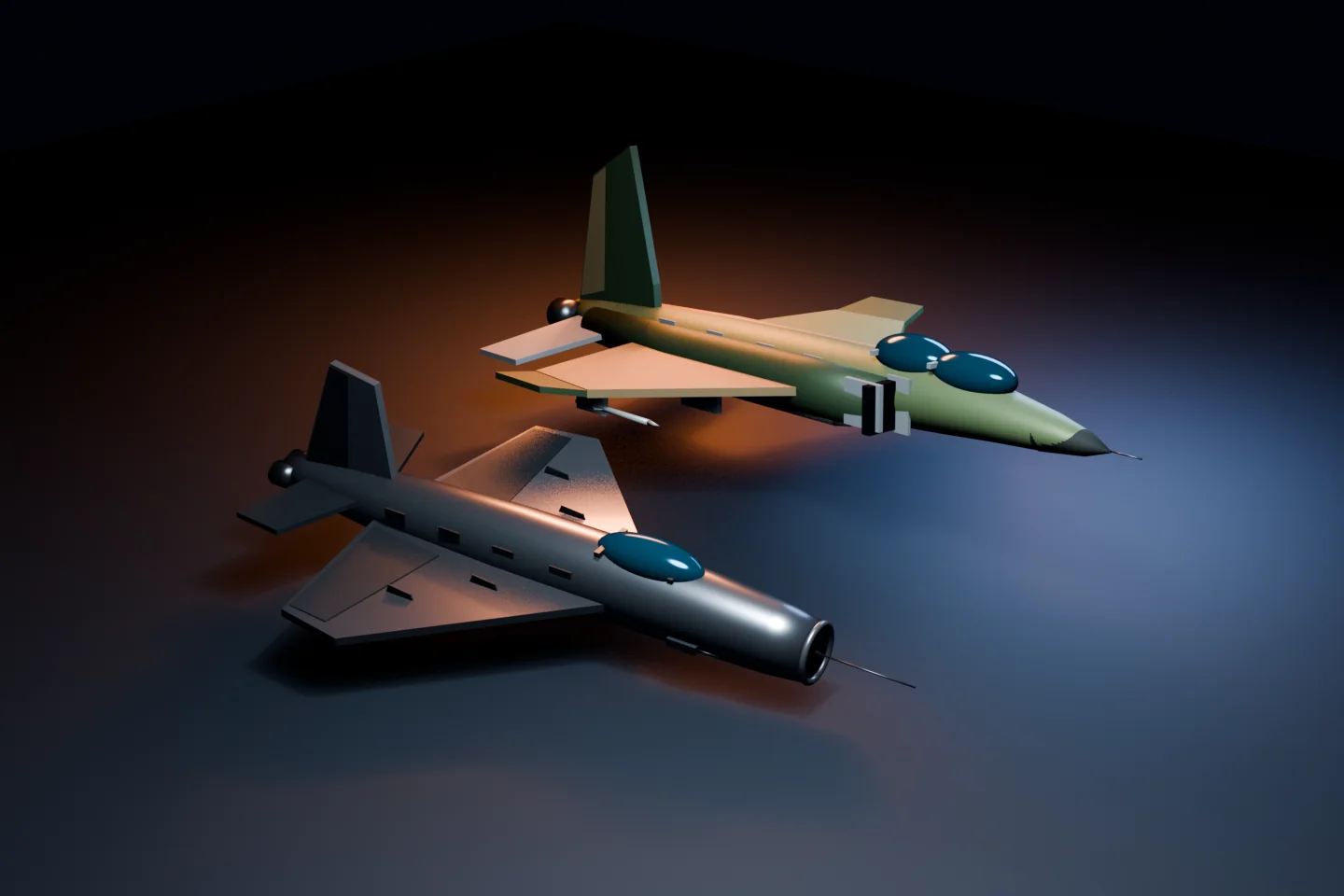
Locally constructed aircraft progressed from simple proxies to more detailed airframes. Separate canopy, intake, exhaust, wing, and tail geometry gives each silhouette a distinct read.
Blender scripts build the meshes and procedural materials. Consistent scale and orientation support FBX transfer into Unreal; the studio and clay views here come from those actual models.
Procedural modeling
Materials & lighting
FBX preparation
THE SHOT
Make the action readable.
Three cameras cover the larger sequence: the pursuit, a cockpit view, and the exterior action. Keyed aircraft motion, contrails, tracers, impact effects, and damage smoke carry the story through a staged landscape.
The silent excerpt follows the firing pass and breakaway. It is rendered from the existing Blender scene, with insignia removed for this presentation. The original edit uses Kdenlive and FFmpeg for assembly and finishing.
This is a stylized cinematic study. Blender produced the picture; Unreal was used for a separate real-time proof, not the finished cut.
02 / Cinematic output — 12-second silent excerpt. Aircraft converge, a firing pass leaves a smoke trail, and the damaged aircraft breaks away. No audio track.
Blender → FBX → Unreal Engine A parallel real-time proof: imported aircraft, physical-scale checks, scene assembly, and an eight-second Sequencer blockout with aircraft and camera transform tracks.
02 / REUSABLE CHARACTER SYSTEMS
Keep the framework. Change the character.
Technical R&D with reusable parts. An evolving part of the practice.
Through character-production experiments, I developed a reusable humanoid framework around MPFB and Rigify. The useful foundation is the skeleton, animation controls, and binding process that connects a mesh to the rig.
The framework combines a generated Rigify rig, IK/FK properties, keyed hand controls, and mesh components with transferred deformation weights. The source rig and animation stay separate from the presentation meshes, providing a starting point for character replacement and motion reuse.
An original character demonstration is still in preparation. The focus here is the reusable rig, binding process, and editable motion that can support future character work.
Skeleton & rig
MPFB human base and generated Rigify deformation skeleton.
Animation controls
IK constraints, IK/FK switches, and keyed pose controls.
Reusable binding
Armature modifiers and transferred skin weights for separate mesh components.
Editable motion
Rig-level actions retained for revision. Baked cloth caches must be rebuilt when the action changes.
03 / HOW I APPROACH PRODUCTION
A shot is a series of working decisions.
Plan, build, test, refine. The same habit behind my software.
01
Plan
Define the shot, action, assets, camera needs, and delivery format. Make the sequence readable before adding detail.
02
Build / Prepare Assets
Construct or clean the geometry, set scale and materials, and prepare the controls or rig the shot needs.
03
Assemble
Bring the assets into a scene. Block the environment, place lights, and establish camera positions in Blender or Unreal.
04
Animate
Shape vehicle paths, character poses, camera motion, and timing. Keep the motion editable so it can respond to review.
05
Review & Iterate
Render test frames and previews, inspect composition and motion, then adjust the assets, cameras, or action and repeat.
06
Polish & Deliver
Refine lighting and effects, finish the edit, and export for the intended screen. Include audio only when cleared for the delivery.
SOFTWARE / SYSTEMS / SCENES
Got a scene in mind?
Tell me the action, the assets you have, and what the finished result needs to do.